
Tesla Has Started Optimus Production. Now the Real Humanoid Robot Test Begins
Tesla has started Optimus production in Fremont. The real test is whether it can build humanoid robots at scale, cheaply and reliably.
Summary
Tesla’s Q3 update says Optimus production began on its Fremont lines, with first production-quality bots. It gave no rate, price, unit count or sales date, and early units are for internal use, so the real test is volume, cost and reliability.
Tesla has started production of its Optimus humanoid robot at its Fremont factory, moving the project beyond prototypes and staged demonstrations into the far harder phase of building real machines repeatedly. The biggest question is no longer whether Tesla can build a capable humanoid. It is whether the company can produce enough of them, cheaply and reliably enough, to turn robotics into a meaningful business.
For years, Optimus existed mostly as a promise. First came the concept, then early prototypes, then increasingly polished demonstrations of the robot walking, sorting objects and handling tools. Now the project has entered a more important stage.
In its Q3 2026 update, published on October 21, Tesla said: "Optimus production began in Fremont on our high-volume lines. The bots coming off this line are the first production-quality bots that we have manufactured." The company added that it has "proven that the current manufacturing process for Optimus is suitable for a commercial product," while continuing to iterate on the hardware and process.
A prototype proves that something can work. Production tests whether it can work repeatedly. In robotics, that difference is enormous.
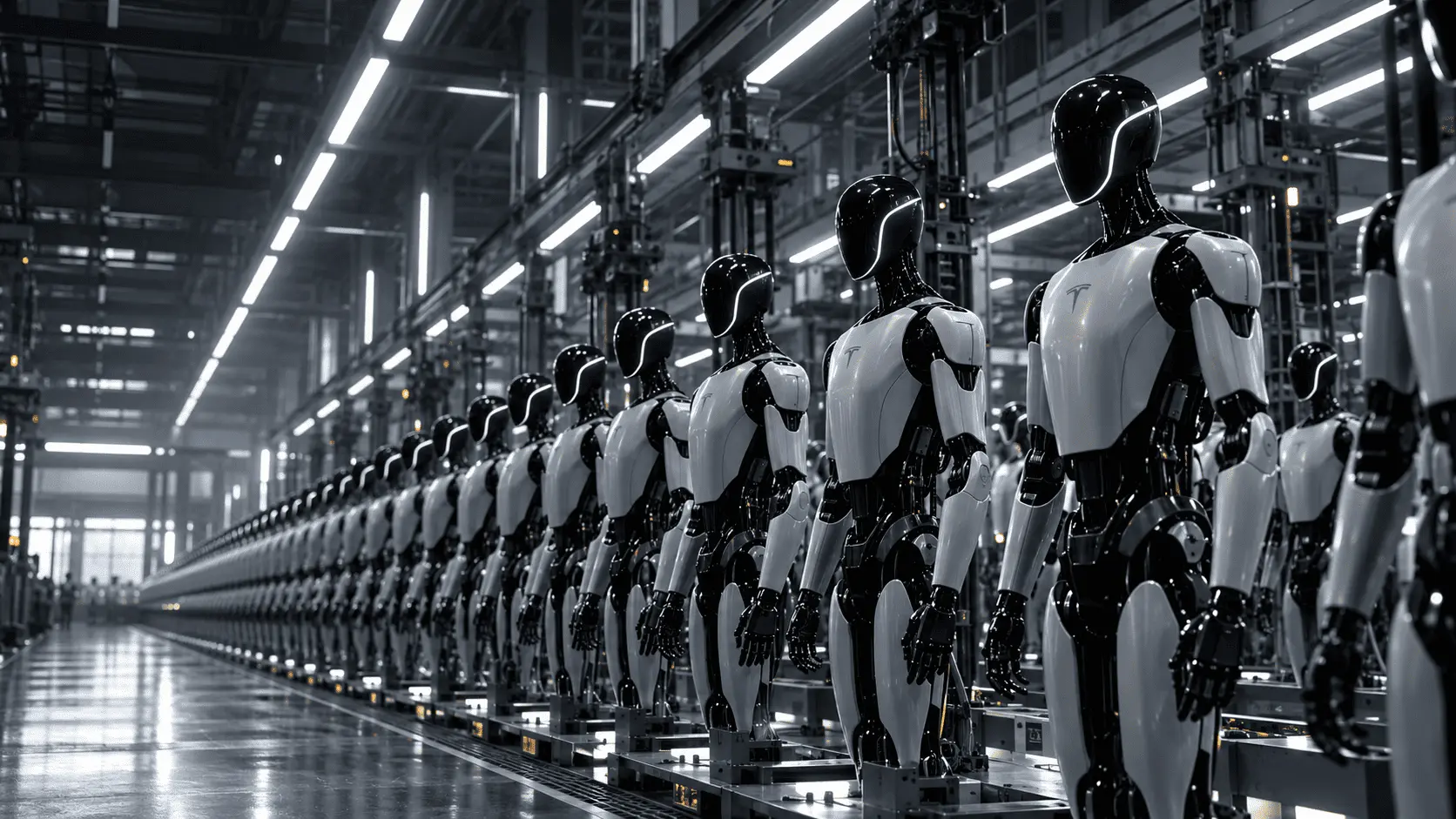
Tesla is now building Optimus, not just demonstrating it
The Fremont line occupies space that previously built the Model S and Model X, both of which Tesla discontinued earlier this year. Elon Musk said in January that the floor space would be used for the robot, with a long-term goal of one million Optimus units a year at the factory.
That goal is a long way from the current position. Tesla's update lists California capacity as "Early Ramp" and Texas, where a dedicated Optimus factory is being built at Giga Texas, as "Construction". Neither entry has a capacity number.
The programme is moving through the transition every serious hardware product eventually faces: research, prototype, pilot production, scale. Optimus is now inside the production phase.
What Tesla has not said
The announcement leaves several important details out. Tesla has not disclosed a production rate, a unit count, a price or a date for selling Optimus to outside customers. It also has not said which version of the robot is being built.
That last point is worth noting. Musk said in April that Tesla would hold back the reveal of Optimus 3 until closer to production, partly to stop competitors copying the design. The production robot has still not been formally unveiled, so claims about its specifications should be treated as unconfirmed until Tesla shows it.
Why starting production matters more than another demo
Humanoid robotics is full of impressive demonstrations. Robots can walk, run, dance, pick up objects and fold materials. None of that automatically creates a commercial product.
The real test begins when a company needs to build the same machine hundreds or thousands of times. Every actuator needs consistent tolerances. Every hand needs to work. Every sensor needs calibration. Every joint needs durability. Replacement parts need to exist, assembly needs to get faster, costs need to fall, and the robot needs to keep working long after the demonstration video ends.
That is why Optimus entering production is arguably more significant than any individual capability demo Tesla has shown so far.
The ramp will be slow
Tesla has been open that scaling will not be instant. Musk warned in April that the initial ramp would be "quite slow", which is normal for complex new hardware. Tesla's vehicle programmes showed the same pattern, where building the first few thousand units proved harder than designing the product.
Optimus may be harder still. A humanoid contains large numbers of compact mechanical systems that must coordinate continuously. The hands alone are among the most complicated parts, needing fine control, multiple degrees of movement and enough sensitivity to handle very different objects without damaging them. Those components are difficult to make cheaply, and a single failed actuator can make a task impossible.
The first customer is Tesla itself
Tesla has an unusual advantage over robotics start-ups: it owns factories. Optimus does not need to convince an outside company to become an early customer. Tesla can test it internally on structured, repetitive work such as moving components, handling materials, sorting parts and transporting objects between workstations.
Tesla has previously said early builds would go towards training data collection in what it calls the Optimus Academy. Factories are a logical starting point because they are far more predictable than homes, and operating experience there can improve reliability, maintenance and performance before any wider commercial deployment.
Tesla still wants enormous scale
Tesla's long-term ambitions remain extremely aggressive. Musk has talked about producing Optimus at very high volume, with a stated goal of a million units a year at Fremont alone. Those numbers are goals, not current output.
Starting production does not mean Tesla is producing at automotive scale. It means the company has begun the process of working out how to get there, and that process could take years. But once manufacturing begins, Tesla can gather the data needed to improve speed, reliability and cost.
Manufacturing may be Tesla's biggest advantage
Many robotics companies can build sophisticated prototypes. Far fewer know how to manufacture complex machines at enormous scale. Tesla already makes electric motors, battery packs, power electronics, vehicles, charging hardware, cast structural components and increasingly AI hardware, and it designs much of the machinery in its own factories.
If humanoids become commercially viable, the winner may not be the company that builds the smartest robot first. It may be the one that can build a capable robot cheaply enough to deploy in the hundreds of thousands. That is the kind of problem Tesla has spent years solving in cars.
The robot still has to be economically useful
Production alone does not guarantee success. A humanoid robot has to justify its cost. A factory deciding between hiring another worker and buying an Optimus would compare purchase price, maintenance, energy use, downtime, supervision, operating life and productivity.
If the robot costs more than the labour it replaces or supports, adoption will stay limited. Tesla needs to bring Optimus to an attractive price while improving reliability, which may matter more than another visually impressive demonstration.
An AI system inside a physical body
The hardware is only half the story. Tesla is developing Optimus with a similar AI philosophy to its driving systems: cameras observe, AI interprets, the system decides, and motors turn that decision into movement.
The difference is that a car has relatively few control outputs, essentially steering, acceleration and braking. A humanoid has to coordinate hands, fingers, arms, legs, torso, balance and navigation at once, which makes the control problem substantially harder. Tesla wants Optimus to eventually learn tasks rather than have engineers programme every movement. That is what would make it genuinely general-purpose.
Why the humanoid form still makes sense
Humanoids are mechanically complicated, so why not build specialised machines? Because almost everything around us is designed for humans: doors, stairs, shelves, tools, workstations, vehicles, factories and homes.
A humanoid could in theory enter those environments without anyone rebuilding them. That flexibility is the central economic argument for the form, and it becomes extremely valuable if the AI is capable enough.
It changes the Tesla story, and the bill is visible
Tesla's identity is moving away from being defined entirely by electric vehicles. Its roadmap increasingly centres on autonomous vehicles, robotaxis, AI computing, energy and robotics. A vehicle automates movement. A humanoid could automate physical work, which is a far larger market, across manufacturing, warehousing, logistics, retail, healthcare, hospitality, construction and eventually homes. That remains a very large assumption.
The cost of the bet is already visible. TechCrunch reports that Tesla's third-quarter revenue was flat at $28.04 billion while net income fell 43% to $787 million, with spending on AI, autonomy and Optimus weighing on profit. Investors are being asked to wait.
The humanoid race is accelerating
Tesla is not alone. Figure, Agility Robotics, Apptronik, Boston Dynamics, Unitree and several Chinese companies are all developing humanoids, and many are moving towards factory trials and commercial production.
The next phase of the race will probably be less about spectacular demos and more about operational metrics. How many robots can you build? What does each cost? How many hours can it work? How often does it fail? How quickly can it learn a new task? How much supervision does it need? Those answers will decide which companies build sustainable businesses.
Production is where hype meets reality
A demonstration can be repeated until the perfect take is captured. A factory cannot work that way. A production robot has to work repeatedly, predictably and safely, and there is nowhere for unreliable hardware to hide.
That makes the start of manufacturing arguably the most important stage Optimus has reached. Tesla now has to prove the robot can leave the laboratory and survive the real world.
Tesla Optimus production: where things stand
| Area | Current position |
|---|---|
| Production | Started in Fremont, per Tesla's Q3 2026 update |
| Version being built | Not disclosed by Tesla |
| Capacity status | California "Early Ramp", Texas "Construction", no figures given |
| Initial use | Primarily internal, including training data collection |
| Production rate, price, external sales | Not announced |
| Long-term goal | One million units a year at Fremont (Musk) |
| Biggest hardware challenge | Hands, actuators and precision components |
| Biggest AI challenge | Reliable general-purpose physical autonomy |
| Commercial challenge | Making robotic labour economically useful |
Frequently asked questions
Yes. In its Q3 2026 update, published October 21, Tesla said Optimus production began on its high-volume lines in Fremont, California, and that the bots coming off the line are its first production-quality units.
Tesla has not said. It gave no production rate or unit count, and its update lists Fremont as "Early Ramp" with no capacity figure. Musk has said the initial ramp will be slow.
Not yet. Tesla has not announced a price or a date for sales to outside customers. Early units are expected to be used internally, including for training data collection.
Tesla has not said. Musk has said the Optimus 3 reveal would be held back until closer to production, and the production robot has not been formally unveiled.
Production has started in Fremont, California, in space that previously built the Model S and Model X. A dedicated Optimus factory is under construction at Giga Texas.