
Sydney Sweeney Doubles Down on Novig's "Just Sports" Campaign. Is the Backlash Becoming the Strategy?
Sydney Sweeney is back with another Novig ad weeks after female athletes criticised the first. When attention is the goal, backlash can stop being a risk and start looking like distribution.
Summary
Novig's "Just Sports" campaign, launched September 9 with strategic partner and equity holder Sydney Sweeney, drew sharp criticism from female athletes and then a follow-up ad rather than a retreat. Controversy generated enormous awareness, but views and coverage are not brand recall or retention. The real test is whether Novig can turn attention into a product people remember once the controversy fades.
Sydney Sweeney has returned with another provocative ad for sports prediction platform Novig, weeks after the original "Just Sports" campaign triggered criticism from female athletes. Instead of retreating, the brand is leaning further into the controversy. From a marketing perspective, that raises a more interesting question, when attention is the goal, does backlash become part of the media plan?
Sydney Sweeney and Novig are not backing away from the campaign that put both of them at the centre of a debate about advertising, women's sport and the use of sexuality in marketing.
Novig originally launched the campaign on September 9 as its first national brand push. The premise was deliberately simple. Unlike broader prediction markets that cover politics and current events, Novig wants to position itself around sports alone. Sweeney joined the company as a strategic partner and equity holder, and Novig described the creative as confident, humorous and intentionally playful.
What is the "Just Sports" campaign?
At its core, Novig is trying to create a very simple piece of brand positioning. One platform. One obsession. Just sports.
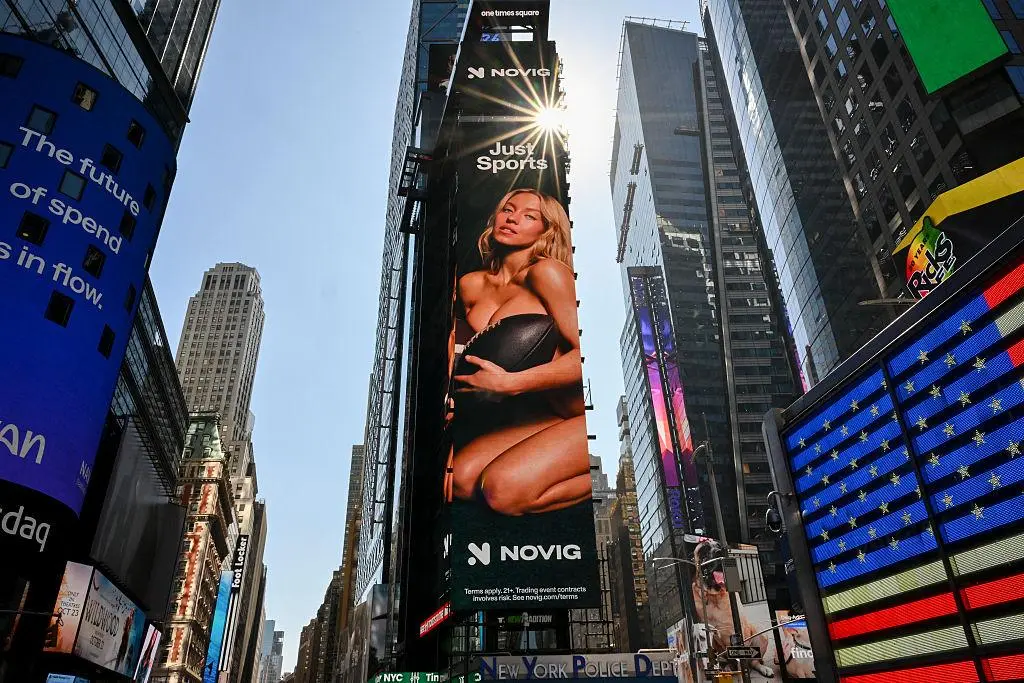
The company says its entire prediction-market product is built around sports, distinguishing itself from competitors whose markets extend into politics, entertainment and other events. The campaign uses Sydney Sweeney as the visual shortcut for that message. She appears alongside sports equipment and Novig branding in imagery designed to generate substantially more attention than a conventional betting-platform launch.
That strategy worked. The campaign quickly moved beyond Novig's own audience and into mainstream discussion.
The campaign generated exactly what Novig needed: attention
Novig is competing in a category where companies such as Kalshi and Polymarket already have significant recognition. That creates a difficult problem for a smaller challenger. Before consumers can care about how your product differs, they first need to know that you exist.
Celebrity campaigns can compress that process dramatically. Sweeney does not simply lend familiarity to Novig. She brings an existing audience, press attention and a cultural conversation that the company would otherwise have to spend heavily to manufacture. The result is an enormous awareness shortcut.
But there is another side to that equation.
Then came the backlash
The campaign quickly attracted criticism from female athletes.
ABC reported that dozens of athletes criticised the advertisement for what they saw as a sexualised depiction of women in relation to sport. Olympic champions and other professional athletes responded by posting their own sporting footage and arguing that athletic achievement, rather than sexualised imagery, should define how women are represented in sport. Axios similarly described the controversy as arriving at a moment when women's sport is gaining greater cultural and commercial influence, making the advertising approach particularly sensitive.

Then came the follow-up. Fox News reported on October 12 that Sweeney had released a new Novig spot that nods to the criticism rather than retreating from it, weeks after the original launch. A rival brand also entered the conversation, with Powerade answering the campaign in Times Square under the line "Never Just Sports." When competitors start responding in your category's public space, the campaign has stopped being just an ad.
Sweeney was more involved than a normal celebrity ambassador
One of the most interesting elements is that Sweeney was not simply hired to stand in front of a camera. Novig says she joined as a strategic partner and equity holder.
CEO Jacob Fortinsky later told Front Office Sports that Sweeney was heavily involved in the creative direction, saying she was driving much of the campaign's visuals and messaging, and that she herself approached the company about a partnership. That changes the nature of the relationship.
Traditional celebrity advertising is usually transactional, brand, celebrity fee, campaign exposure. This looks closer to celebrity, ownership, creative input, audience distribution, potential upside. That model is becoming increasingly common. Celebrities are no longer satisfied with simply being paid to advertise growing companies. They increasingly want equity in the growth their influence helps create.
Is controversy becoming part of the strategy?
There is no evidence that Novig deliberately set out to provoke female athletes. But there is a difference between accidentally creating controversy and deliberately creating advertising designed to be provocative. The original Novig campaign clearly falls into the second category. The creative was meant to attract attention.
What the company could not fully control was the interpretation. That is where modern advertising becomes interesting. Once the public conversation starts, the campaign no longer belongs entirely to the brand. Critics reinterpret it. Supporters defend it. Athletes respond to it. Publications analyse it. Social accounts repost it. And every reaction generates another opportunity for the brand name to appear.
Attention has become a form of distribution
Traditionally, brands bought attention. Television slots. Billboards. Digital advertisements. Sponsorships.
Social media created another possibility, make something people distribute for you. Controversy is particularly effective at doing this because opposition itself creates reach. Someone sharing an ad to explain why they dislike it is still sharing the ad. News outlets covering the criticism still repeat the brand name. Reaction videos extend the lifecycle. Search demand rises. What was initially advertising becomes culture.
This is why controversial marketing remains attractive despite the reputational risk. It can generate distribution that would be extremely expensive to purchase directly.
But virality is not the same as brand success
This is where the campaign becomes more complicated.
Imagine someone remembers "that Sydney Sweeney sports ad" but cannot remember Novig. From a brand perspective, the celebrity has won, but the company has not necessarily won. There are several levels of campaign performance.
| Metric | What it tells us |
|---|---|
| Views | People saw the campaign |
| Shares | People considered it worth distributing |
| Media coverage | The campaign entered public discussion |
| Brand recall | People remember who made it |
| Search interest | People actively investigated the brand |
| Registrations | Attention converted into users |
| Retention | Users found lasting product value |
| Revenue | Awareness produced commercial results |
A controversial campaign can dominate the first three while still struggling further down the funnel. That is why the real test for Novig is not whether Sweeney can make people look. She clearly can. The test is whether Novig can make those people care about the product afterward.
The campaign also reveals a larger shift in celebrity branding
Sweeney's equity position matters because it reflects a broader change. Celebrities are increasingly moving from endorser to business partner.
That makes sense. If someone's name, image and audience can significantly increase a company's value, receiving only an advertising fee may no longer look attractive. Equity gives the celebrity exposure to the upside. For startups, the exchange can be equally valuable. Instead of spending years slowly building awareness, they can gain immediate cultural relevance through one partner.
But this also increases reputational dependency. The celebrity and the company become more closely connected. A controversy surrounding one affects the other.
The Darwin Corp perspective
The most interesting lesson from Novig is not whether the advertising is tasteful. It is how the campaign demonstrates a new relationship between attention, controversy and distribution.
Modern advertising is increasingly circular. Campaign, reaction, press coverage, social response, more attention, new campaign. Once that loop begins, public reaction becomes part of the creative ecosystem. That can be enormously powerful.
But there is also a danger. A brand that learns controversy is the fastest way to generate attention may eventually become dependent on controversy to remain interesting. Then every new campaign has to be louder than the last.
Novig has already achieved something that most young companies struggle to accomplish, people know its name. The next question is considerably harder. Can it build a product and brand that people remember after the controversy disappears?
This article is an independent brand analysis by Darwin Corp, based on public reporting. Written by Hasaka
Frequently asked questions
It is Novig's first national brand campaign, launched on September 9, 2026, starring Sydney Sweeney. It positions the prediction-market platform around sports only, distinguishing it from competitors whose markets also cover politics and current events.
ABC reported that dozens of athletes criticised the ad for what they saw as a sexualised depiction of women in relation to sport. Many responded by posting their own sporting footage, arguing that athletic achievement should define how women are represented in sport.
Novig says Sweeney joined as a strategic partner and equity holder. CEO Jacob Fortinsky told Front Office Sports she was heavily involved in the campaign's visuals and messaging.
There is no evidence Novig set out to provoke female athletes, but the creative was clearly designed to attract attention. How the public interpreted it was outside the company's control, and the brand has since continued with a new spot rather than retreating.
It can generate large amounts of awareness, press coverage and social distribution cheaply. But views and coverage are not the same as brand recall, registrations or retention, so the real test is whether attention converts into lasting customers.